GSTN Advisory on Interest Calculation & GSTR-3B Enhancements (Effective January 2026)
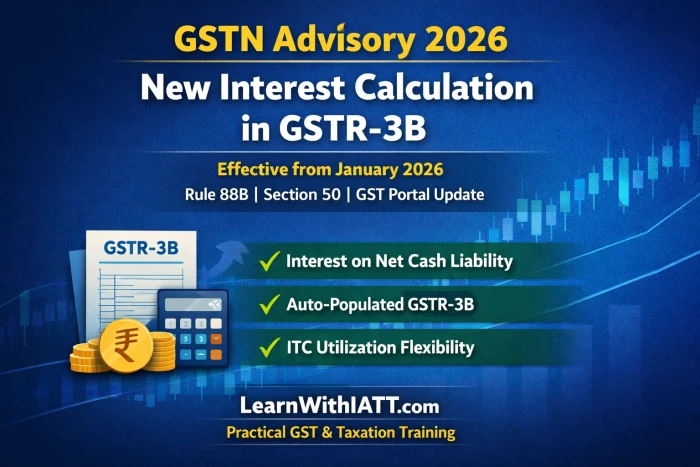
The GST Network (GSTN) has issued an important advisory introducing significant enhancements in GSTR-3B filing, applicable from the January 2026 tax period onwards. These changes primarily focus on interest computation, tax liability reporting, ITC utilization flexibility, and interest recovery in case of cancelled registrations.
The objective of this advisory is to align system-based computations with Section 50 of the CGST Act, 2017 and Rule 88B of the CGST Rules, while ensuring greater transparency and ease of compliance for taxpayers.
From the January 2026 tax period, the GST portal will auto-compute interest in Table 5.1 of GSTR-3B by giving benefit of the minimum cash balance available in the Electronic Cash Ledger (ECL) from:
Due date of return filing till the actual date of tax payment (offset)
This enhancement follows the proviso to Rule 88B(1) of the CGST Rules, 2017.
Interest will be auto-populated by the GST portal
The auto-calculated interest is non-editable downward
Taxpayers may increase the interest amount, if self-assessed liability is higher
Auto-populated interest represents the minimum interest payable
? Important Note:
For delayed January 2026 GSTR-3B, interest will appear in the February 2026 GSTR-3B.
This table captures tax liability pertaining to previous tax periods, which is reported and paid in the current GSTR-3B.
From January 2026 onwards, the GST portal will auto-populate the Tax Liability Breakup Table based on:
Invoice / document dates
Data reported in GSTR-1, GSTR-1A, or IFF
Tax paid in the current GSTR-3B
? Navigation Path:
Auto-populated values are suggestive
Taxpayers may modify values upward, if required
Final responsibility of correctness remains with the taxpayer
From January 2026:
Once IGST ITC is fully exhausted
The GST portal will allow payment of IGST liability using CGST and SGST ITC
Utilization can be done in any sequence
This change improves system flexibility while remaining subject to Section 49 of the CGST Act.
In cases where:
GST registration is cancelled
The last applicable GSTR-3B was filed after the due date
➡️ Interest on delayed filing will now be levied and collected through GSTR-10 (Final Return).
This ensures recovery of statutory interest even after cancellation of registration.
✔ Fair and law-aligned interest calculation
✔ Reduced disputes on interest liability
✔ Better tracking of prior-period tax payments
✔ Improved automation and compliance accuracy
Maintaining sufficient balance in the Electronic Cash Ledger before the due date can significantly reduce interest liability on delayed GSTR-3B filing.
Taxpayers and professionals should carefully review auto-populated figures and ensure timely compliance to avoid unnecessary interest costs.
This article is prepared for educational and informational purposes only and does not constitute legal advice. Taxpayers are advised to refer to applicable provisions of the GST Act, Rules, Notifications, and official GSTN advisories for statutory compliance.